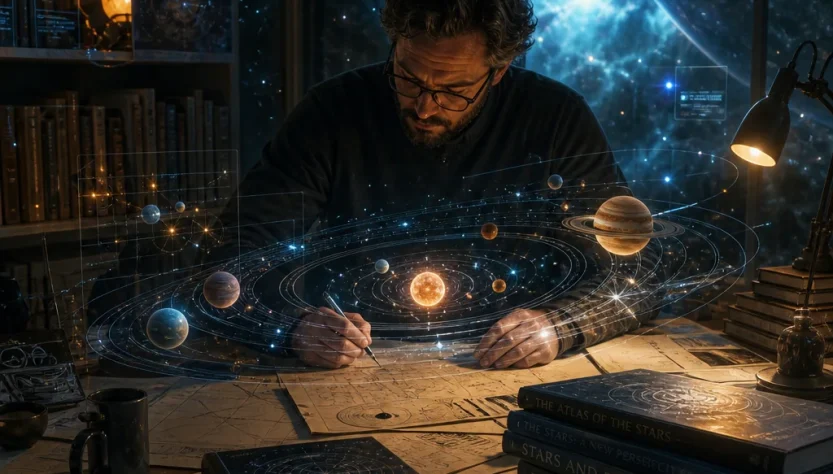
Science fiction has always borrowed from astronomy, but the relationship runs deeper than most readers suspect. The genre does not simply decorate its stories with planets and stars. It feeds on the actual rules of the universe, and those rules turn out to be far stranger than most human inventions. When a writer opens an astronomy textbook looking for a setting, they usually leave with a plot. Real physics supplies deadlines, obstacles, moral dilemmas, and endings that nobody would invent from scratch. That is why the most convincing speculative stories tend to be the ones that take the sky seriously, even when they bend its laws for narrative effect.
Why Orbital Mechanics Makes Better Plots Than Magic
Gravity is not a passive background detail. It is a strict resource budget, and every spacecraft in a realistic story spends from it. The most useful concept in orbital mechanics is the transfer window: the narrow chronological period when two celestial bodies align so that a reasonable amount of propellant gets you from one to the other. Miss that window and you do not simply try again tomorrow. You wait months or years, and the wait itself becomes organic drama. Andy Weir built an entire survival narrative around this exact principle, turning a launch window into an unforgiving ticking clock that no villain could improve on. The same logic powers stories about deep-space cargo runs, high-stakes rescue missions, and fragile colony supply lines. A writer who understands delta-v—the total velocity change a mission can afford—gains something rare: a source of conflict that is completely impersonal and completely fair. Nobody is being intentionally cruel; the geometry of the solar system simply does not care, and characters must live with that absolute indifference.
Light Speed as the Universe’s Cruelest Deadline
Radio signals travel at the speed of light, which feels instantaneous on Earth until you venture into the void. A message to Mars takes anywhere from three to twenty-two minutes depending on the orbital positions of both planets. A real-time conversation instantly degrades into a series of delayed monologues. At interstellar distances, the lag is measured in years. This single physical constraint reshapes entire speculative genres. A stranded crew cannot call for immediate help, a fleet admiral cannot micromanage a skirmish, and a family cannot learn what happened until the news is already historical record. Writers who use this lag honestly produce scenes of extraordinary psychological isolation: a character refreshing a queue of messages that will always be out of date. It also generates a robust political texture. Any civilization spread across light-years is necessarily a collection of independent voices, because no central authority can react fast enough to matter. The speed of light is not a narrative limitation; it is one of the most powerful dramatic engines astronomy ever handed over to creators.
Black Holes, Time Dilation and the Cost of Accuracy
Few astronomical objects have done more for modern cinema than the black hole. The reason is not merely the visual spectacle, but the underlying mathematics. Near an extremely massive object, clocks run at drastically different rates, and the variance steepens the closer you get. A planet orbiting in close proximity to a supermassive black hole could experience mere hours while decades pass elsewhere in the universe. That is a classic science-fictional premise loaded with an emotional bill: every minute spent exploring is paid for by everyone left behind. The visual language of these objects is equally grounded in reality. Gas spiraling inward heats up and glows brightly, which is why authentic images of distant black holes reveal a luminous ring rather than a pure dark disc. The dark core is simply the shadow, the region where light itself is captured by gravity. None of this requires a writer to possess a doctorate in astrophysics; it requires only that the logical consequences be followed through to their end.
Exoplanets and the New Frontier of Plausible Worlds
For most of literary history, fictional planets were improvised snapshots. Today, they compete with a vast catalogue of thousands of confirmed exoplanets, and the real worlds discovered by telescopes are frequently weirder than anything invented. There are gas giants orbiting so close to their parent stars that their entire years last a matter of days. There are worlds tidally locked with one face permanently turned toward their sun, creating scorched hemispheres on one side and frozen wastelands on the other, separated by a narrow, howling temperate band. Each of these unique arrangements dictates specific weather systems, alien geology, and distinct survival strategies. A tidally locked world with an ocean would feature permanent, raging storms along its terminator line. Writers who start from these verifiable details craft settings that feel deeply researched rather than randomly generated.
Dying Stars and the Physics of Apocalypse
The universe offers cosmic catastrophes far more imaginative than most human villains. A massive star at the end of its life cycle collapses and then rebounds, releasing in mere seconds more energy than our Sun will produce across its entire lifetime. A star stripped of its outer layers can spin down into a pulsar with a magnetic field so intense that it distorts the atomic structure of anything nearby. A focused beam of gamma radiation from a distant hypernova, aimed almost directly at an inhabited planet, could strip away an atmosphere before the inhabitants even understood the danger. These are not literary inventions; they are observed astrophysical phenomena with estimated rates and lethal radiuses. That gives a writer a valuable asset: an apocalypse with a strict timetable and a clear physical mechanism, grounding dread in patience rather than cheap shock value.
The One Big Lie: How Writers Trade Accuracy for Story
Total scientific realism is rarely the goal, and no working author pretends otherwise. The golden rule of speculative worldbuilding is to spend your scientific impossibilities very carefully. Choose one big lie—whether it is faster-than-light travel, artificial gravity, or a convenient wormhole—and keep everything else strictly honest. If a ship can cross the galaxy in a week, then the arrival time still matters, fuel consumption still matters, and the socio-economic consequences of being early or late must still be addressed. When a story continuously adds convenient exceptions, audiences lose trust in the stakes. The writers who handle this best treat their chosen scientific lie as a fixed physical law and then explore its realistic secondary ripples across society and technology.
Radiation, Dust and the Unglamorous Truth of Space Travel
The least cinematic hazards of spaceflight are frequently the most instructive for worldbuilders. Space is not an empty vacuum; it is saturated with energetic particles from the Sun and deep galactic sources, and biological exposure accumulates steadily. A long-duration mission requires massive shielding, and mass is expensive, meaning crews might end up sheltering inside a central water tank during a solar storm. Planetary surfaces present their own hostile conditions. Lunar and Martian dust is microscopically sharp, abrasive, and electrically charged, stubbornly clinging to every suit and invading human lungs. Zero-gravity environments weaken bones and muscles, and those physiological effects do not vanish the moment a landing is made. Integrating these gritty operational details forces characters to solve small, physical problems under intense pressure, giving a story unmistakable authenticity.
Spectroscopy: Reading Worlds Without Visiting Them
Almost everything modern astronomy knows about distant objects arrives encoded in light. When an exoplanet transits across the face of its parent star, a thin sliver of starlight filters through its atmosphere, and the ambient gases absorb specific wavelengths. The resulting spectral fingerprint can reveal water vapor, carbon dioxide, methane, or cloud cover. This indirect method of discovery is fundamentally a story of interpretation: the evidence is circumstantial, the signal is weak, and conclusions are always provisional. That represents exceptionally fertile ground for fiction. A crew detecting an ambiguous chemical anomaly in a planetary atmosphere must argue fiercely about its true meaning before taking action. The real drama lives precisely in that gap between raw data and definitive understanding.
What the Next Decade of Astronomy Will Give Storytellers
Every generation of new instruments hands writers a fresh vocabulary and updated imagery. Larger space-based telescopes gather deeper light and resolve smaller terrestrial worlds. Infrared observatories peer through thick cosmic dust, exposing the dark nurseries where stars are born. Meanwhile, sustained robotic and human missions to the Moon and Mars will continue to supply concrete, visceral details about regolith, subsurface ice, and the psychology of living in confined, hostile habitats. None of this dictates what specific plots get written, but it dramatically raises the baseline for plausibility. A reader who has gazed upon a high-resolution image of a distant black hole is much harder to impress with a generic swirling vortex. Reality keeps winning.
A Practical Checklist for Writers
Begin your worldbuilding with travel time and work outward from there. Decide precisely how long journeys take, and determine what your characters do to endure the wait. Choose your single big scientific lie and write it down so the rest of the narrative respects its boundaries. Research the actual environment of your setting: its temperature extremes, atmospheric composition, solar radiation levels, and weather mechanics. Ask what breaks first under pressure, because mechanical equipment always fails long before human ideals do. Finally, remember that scientific accuracy is not identical to realism. A story does not need every decimal point to be correct, but it must maintain logical structural integrity. Astronomy offers unbreakable deadlines, vast distances, and indifferent catastrophes—the exact ingredients exceptional fiction requires.